Monday, December 3, 2012

TRANS-ATLANTIC SLAVE TRADE REVISITED

 Posted here on 3/12/2012.

Transatlantic slave trade

Marxist anti-Imperialist  Historian and writer Dr. Walter Rodney once a Lecturer at University College, Dar-es-salaam (Mlimani), begins his booklet West Africa and the Atlantic Slave-Trade with the following words:
 "It must always be remembered that the Atlantic slave-trade was an event in world history, involving three continents - Europe, Africa and America. The people who set out to seek slaves were Europeans coming from every country between Sweden in the north and Portugal in the south. The Portuguese arrived in West Africa shortly before the middle of the fifteenth century. Immediately, they started seizing the Africans and taking them to work as slaves in Europe, particularly in Portugal and Spain. But the most important developments took place in the sixteenth century, when Europeans capitalists realised that they could make enormous profits by using the labour of Africans to exploit the wealth of the Americas. As a result, Africans were taken to North America, Central America, South America and the Caribbean to provide slave-labour in gold and silver mines and on agricultural plantations growing crops of sugar, cotton and tobacco. This notorious commerce in human beings lasted altogether for more than four hundred years (400 years) since the Atlantic slave-trade did not come to end until the late 1870's."


"Much can be said about the way that the Atlantic slave-trade was organised in Europe, and about the vast profits made by countries such as England and France. A lot can also be said about the terrible journey from Africa to America across the Atlantic ocean. Africans were packed like sardines on the slave-ships, and consequently died in great numbers."


Also check his  compare and  contrast and an overview  analytical  argument  between Arab Slave Trade (East African Slave Trade)  and European Slave Trade (TransAtlantic Slave Trade) in his book How Europe Underdeveloped Africa.
Rodney, Walter., West African and the Atlantic Slave-Trade (Dar-es-salaam: The Historical Association of Tanzania, 1967)

TATHMINI YA MKUTANO MKUU WA CCM 11 - 14 NOVEMBA, 2012, DODOMA, TANZANIA


TATHMINI YA MKUTANO MKUU WA CCM
Karume “mpuuzi”, lakini ukweli wake mchungu
Toleo la 270
28 Nov 2012
MAKALA hii itahitimisha tathmini yangu kuhusu Mkutano Mkuu wa 8 wa CCM uliofanyika Dodoma tangu Novemba 11 hadi Novemba 14 mwaka huu.
Kwa kuwa Chama cha Mapinduzi (CCM) ni chama dola, vimbwanga vyake huwa vinachanganya watu na kuamini kuwa kila baada ya Mkutano Mkuu, CCM huwa inazaliwa upya.
Imani hii imejengeka kutokana na ukweli kuwa, kabla ya Mkutano Mkuu, huwa kuna dalili za migawanyiko na mipango kadhaa ya makundi kutaka agenda zao zishinde.
Kutokana na udhibiti wa vyombo vya dola pamoja na ushabiki uliopitiliza, mipango hiyo huwa inakwama na kuwafanya watu wengi kuamini kuwa CCM ina wenyewe, na wenyewe hao huwa wanaifanya izaliwe upya kila baada ya Mkutano Mkuu!
Historia ya dhana hii ni ndefu, na wahanga (victims) wa mkakati huu kwa miaka ya karibuni ni Salmin Amour (Komandoo), Mzee John Malecela, Dk. Gharib Bilal, Samuel Sitta na sasa Edward Lowassa.
Kwa miaka ya nyuma wanakumbukwa Mzee Aboud Jumbe na Sharrif Hamad. Kwa sababu zilizo wazi, mkakati huu wa kuipa uhai mpya CCM huwa unawaathiri sana Wazanzibari kuliko Watanganyika.
Rais Karume na “upuuzi” wake
Kama Makamu Mwenyekiti anayemaliza muda wake, rais mstaafu Amani Karume alikaribishwa kutoa nasaha zake siku ya kufunga mkutano. Alitoa hotuba, ambayo hivi sasa inaitwa ya kipuuzi huko Magogoni na mtaa wa Lumumba.
Hakuna aliyetarajia kuwa Karume angesema maneno aliyoyasema siku hiyo kiasi cha Mwenyekiti Jakaya Kikwete kukiri kuwa “hajawahi kumwona amefurahi kiasi hicho” kama alivyomwona siku hiyo.
Mara kadhaa hotuba yake ilikatishwa na watu waliomzomea na kumtaka amalize na kukaa. Hii ikakumbusha enzi za uenyekiti wa Benjamin Mkapa wakati wanamtandao wa Kikwete walipokuwa wakimzomea kila mtu aliyetaka kuhoji matumizi ya rushwa katika mkutano huo.
Mzee Joseph Butiku anaikumbuka hii na aliiandikia barua rasmi kwa Mwenyekiti Mkapa. Hii itukumbushe kuwa zomea zomea haikuanza na CHADEMA katika mikutano.
Alipozomewa sana, Rais Karume akawafananisha wazomeaji na vinywa vya samaki! Wapo waliodai, Rais Karume alikuwa kalewa sana konyagi siku hiyo. Awe alilewa au hakulewa; ni mpuuzi au si mpuuzi; kwangu mimi si habari. Habari muhimu ni yale aliyoyasema kwa dakika alizopewa.
Karume alizungumzia kadi yake ya ASP (Afro Shiraz Party); akaelezea madhumuni ya ASP; akamwuliza Dk. Shein ikiwa yeye anayo kadi yake ya ASP. Moja ya madhumuni ya ASP akakumbusha kuwa ni kulinda uhuru wa Zanzibar na watu wake. Ndipo akahoji wale wanaowazuia wenzao wasitoe maoni yao kuhusu Muungano.
Akamkumbusha Rais Kikwete kuwa alitoa ruhusa kila mtu aseme anachotaka wakati wa mchakato wa kutoa maoni ya katiba mpya. Akahoji iweje sasa wengine wanakamatwa kwa kutoa maoni yao. Karume akakumbusha jinsi CCM ilivyopoteza baadhi ya majimbo kwa sababu ya kupuuzia maoni ya wananchi. Akakumbusha suala la zamu kati ya mbunge na mwakilishi katika jimbo fulani. Wazomeaji hawakutaka kusikia haya wakamwimbia taarabu ya “uamsho uamsho”.
Niseme wazi hata kama nilichoka nikakaa nje ya ukumbi wakati anaongea, Karume alisema mambo ya maana kuliko hotuba za masaa zilizotolewa na waheshimiwa wengine. Kwa muda mfupi, Karume aliuzodoa udikteta unaoabudiwa ndani ya CCM; alibainisha hatari zinazoukabili Muungano; alikumbusha habari za zamu za kuongoza nchi hii iliyotokana na nchi mbili; na zaidi sana alisema kutoka moyoni kuwa ASP haijafa kwa sababu waliokuwa wanachama wake wangali bado hai. CCM tumeze au tuteme, huo ndio ukweli kutoka kwa Karume, ambao sasa unaitwa ni upuuzi na akina Nape Nnauye.
Kulialia na kulalama kulizidi mno
Kwa siku tatu, Watanzania walishuhudia wajumbe zaidi ya 2000 wakilialia na kulalamika ndani ya ukumbi. Mwenyekiti alizindua uliaji huo na kupokewa na wajumbe kwenye vikao visivyo rasmi katika nyumba za kulala wageni na kwenye magari. Kivuli cha Chama cha Denokrasia na Maendeleo (CHADEMA) kiliwatesa sana wajumbe na kuwafanya viongozi kupoteza mwelekeo na kuanza kutukana ovyo ovyo.
Haikutarajiwa kuwa Mwenyekiti naye angeingia katika mtego huo, pale alipojikuta anawatukana wapinzani na hasa CHADEMA kwa kuwaita “watu wazima ovyo”, au pale ndani ya NEC alipojikuta anatumia muda mwingi kumpamba Nape Nnauye kwa kuwa anajua kutukanana na CHADEMA. Hata pale alipokumbushwa na rafiki yake kuwa kuitukana CHADEMA si lazima kuijenge CCM, yeye aliishia kusema “wamezidi acha Nape awashughulikie”. Kazi inayomshinda yeye, anaona ni bora aifanye Nape. Kama Mzee Rashidi Kawawa alivyokuwa kwa Mwalimu, Nape ndivyo kwa Kikwete!
Mzee mkorofi kutoka Nyanda za Kusini alihoji, inakuwaje CHADEMA iwe tishio kwa CCM kuliko ufisadi na rushwa ulivyo tishio? CHADEMA inakuwaje tishio kuliko “unduguneizesheni” unaotafutiwa nafasi ya kutambuliwa kwenye katiba ya chama chetu?
Akasema, inakuwaje washauri wakuu wa Mwenyekiti wa chama chetu kuhusu masuala ya chama, si vikao bali ni wanausalama waliojaa fitina? Huyu naye alikuwa analalama sawa tu na wengi waliokuwa wanalalamika kwa siku tatu za mkutano.
Membe: Alimzamisha Mangula; Amemuibua tena.
Nafasi ya Bernard Membe kwa siasa za taifa hili kwa siku za usoni ilikuwa katika mtihani mgumu sana. Kambi ya rafiki yake wa zamani Edward Lowassa ilipania kumzamisha lakini akaokolewa na Kikwete na familia yake.
Kikwete alimsaidia kwa kubadili ratiba za upigaji kura, wakati familia yake (mkewe na mtoto wake) walihaha kila kona kumtafutia kura Bernard Membe. Taifa hili siku moja litadai kujua ukweli wa uhasama na urafiki wa watu hawa watatu – Membe, Kikwete na Lowassa. Jina Kikwete limekaa katikati kwa makusudi. Yeye ni ufunguo wa kitendawili hiki. Hili tuliache kwa sasa.
Mzee Philip Mangula, akaibuka ghafla kuwa Makamu Mwenyekiti wa CCM-Bara. Ni huyu huyu ambaye kundi la mtandao lililomwingiza Ikulu Kikwete lilidai alilitesa sana wakati wa kampeini na kuamua kumtosa mara baada ya Kikwete kuapishwa.
Yasemekana, Benard Membe, kachero mzoefu na kiini cha mikakati ya wana mtandao asilia, alimwambia Kikwete kuwa Mangula aliwapa taabu sana hivyo aondolewe kwenye nafasi ya ukatibu mkuu wa chama. Haikuishia hapo, Mzee Mangula alipojaribu kuibukia Iringa kama Mwenyekiti wa Mkoa alishughulikiwa vikali na kuangushwa na mtu asiyefanana na CCM kwa vigezo vyote.
Mzee Mangula alikiri baadaye kuwa ndani ya CCM uongozi uko mnadani na wapiga kura hawataki tena vipeperushi vya wagombea, bali wanataka “vipeperushwa”. Mzee Mangula, kila anapokumbushwa harakati za wana mtandao, huwa anatania kuwa yeye aliponzwa na “faili maalumu”.
Kuna habari kuwa Mzee Mangula kaibuka kwa mkono wa Membe. Kwamba, vikao kadhaa vilifanyika Makambako kati ya wawili hawa. Iwe kwa Membe kujituma au kutumwa, ni kwamba walikutana na agenda ilikuwa ni uchaguzi katika Mkutano Mkuu wa 8.
Aliombwa radhi au hakuombwa, hilo sasa si habari. Habari ni kuwa, Mkutano Mkuu umempitisha Mzee Mangula kuwa Makamu Mwenyekiti wa CCM lakini mshenga mkuu alikuwa Membe. Kama ushenga huu ulikuwa ni kwa manufaa ya chama au kwa manufaa ya mtandao wake anaouunda kwa ajili ya 2015, ni suala la wakati.
Ikiwa ni kweli, basi itakuwa vigumu kukemea mitandao ndani ya chama hiki kikongwe. Kama mtandao wa Membe ni halali, wa Lowassa hauwezi kuwa haramu. Kama Kikwete aliingia kwa mtandao, ni vigumu kuifikiria CCM na urais bila mtandao. Na tumejifunza kwa uchungu kuwa mtandao hauishii katika uchaguzi kwa sababu, baada ya mtu wao kuchaguliwa, kinachofuata ni kufaidi jasho na matunda ya kazi.
Kwa walioshindwa, kuna kazi ya kutathmini ni wapi wamekwama na kuazimia aluta continua. Ni ndoto kuambiana kuvunja makundi wakati anayeshinda na kuingia Ikulu anaendelea na kundi lake.
Jambo moja tu Mzee Mangula alizingatie. Membe anayedaiwa kumzamisha baada ya uchaguzi wa mwaka 2005 mbele ya Kikwete, hawezi kugeuka leo na kumtetea kuwa ni mtu mzuri anayekifaa chama. Kwa nini hakufaa mwaka 2005 chini ya Mwenyekiti huyuhuyu? Membe ni yule yule, Mwenyekiti ni yule yule, chama ni kile kile na Mangula ni yule yule! Ni kitu gani kimebadilika kumfanya Mangula asiyefaa mwaka 2005, afae mwaka 2012?
Kinachoonekana lakini hakizumguziwi waziwazi, ni ukweli kuwa Kikwete na Membe wanamwona swahiba/hasimu wao Lowassa kuwa sasa ni zaidi ya mgombea urais wa CCM 2015. Kwao, Lowassa amegeuka kuwa chama; ameiteka CCM mbele ya macho yao na wanadhani Mangula atawasaidia kuiokomboa CCM iliyo mateka mikononi mwa Lowassa. Kikwete na Membe hawajiulizi ni kitu gani kimemjenga Lowassa na kumfanya kuiteka CCM.
Kitendo cha kumkimbilia aliyekuwa “adui” yao na chama chao kuwa aje kuwasaidia kukijenga chama walichokibomoa kwa mikono yao, hakieleweki. Wengi tulidhani, Mkutano Mkuu ungepata nafasi ya kutathmini hali hii, badala yake tukaambulia kulialia na vijembe visivyo na mpangilio. Tusubiri Mkutano Mkuu mwingine maalumu au ule wa 2017.
Chanzo: Gaezeti la RaiaMwema

Monday, November 26, 2012

LEUKODYSTROPHY IS AGEEING BACKWARDS MICHAEL AND MATTHEW CLARK OF UK

 Posted here on 27 November, 2012.

Real Benjamin Buttons Brothers: Matthew and Michael Clark Are Aging Backwards


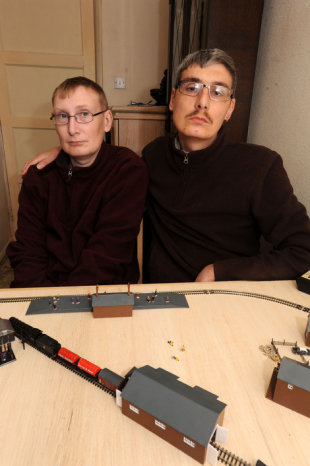
The Clark brothers (courtesy of Channel4)By the looks of their home, Tony and Christine Clark are raising two rambunctious 7-year-old boys. Model train tracks and Monopoly pieces are scattered on tables and cartoons flicker on the TV set.

But the Clarks' two sons are grown men who share only the same interests and emotional fluctuations of little boys. Like the character portrayed by Brad Pitt in the 2008 film "The Curious Case of Benjamin Buttons," Matthew, 39, and Michael, 42, are aging backwards.

Diagnosed with a terminal form of leukodystrophy, one of a group of extremely rare genetic disorders that attack the Myelin, or white matter, in the nervous system, spinal cord, and brain. In the Clarks' case, the condition has not only eroded their physical capacities, but their emotional and mental states as well.
Only six years ago, both brothers were holding down jobs and growing their families. Today, they spend their days in the care of their parents, both in their sixties, playing with Mr. Potato Head, fighting over Monopoly, and in rare lucid moments, struggling to understand why their lives have changed so dramatically.  The 2008 fantasy movie is one of the few popular frames of reference for a very real and frightening disorder.

Before the Clark Brothers were diagnosed, they were living independent lives. Michael served in the Royal Air Force and later became a cabinet maker. Matthew worked in a factory and was raising a teenage daughter. Tony and Christine, meanwhile, had retired and moved from the UK to Spain. Then in 2007, both of their sons fell off the radar. They stopped returning their parents' calls and texts, and as the Clark brothers' conditions developed, their lives fell apart. 


Michael surfaced in a soup kitchen, and was referred to medical experts by social workers. After an MRI scan, he was diagnosed with the incurable degenerative disorder. Soon after Matthew received the same news. In the U.S. alone, about 1 in 40,000 children are born with a form of the neurodegenerative disease, according to Dr. William Kintner, President of the United Leukodystrophy Foundation. While some forms of the disorder are potentially treatable if discovered in the earliest stages and not all cause an emotional regression, the brothers are unlikely to be cured. "It's very difficult to do anything once progression has occurred," Dr. Kintner tells Yahoo! Shine.
With their train set.(Courtesy of Channel4)
As of April, when the Clarks were first written about in the British press, their mental age was 10.
"We will be out walking and things which might interest a toddler interest them, the other day we were walking home when Michael saw a balloon and pointed it out to us," father Tony Clark, told The Telegraph last spring.
Today, the brothers are even younger mentally.
"Just like small children, they wake up a lot during the night," mom Christine said in an interview published in The Independent this week. "I was up seven times with them last night."
After learning of their diagnoses, Tony and Christine returned to the UK and moved in with their sons. Their daily struggles as a family have been chronicled in a British documentary, "The Curious Case of the Clark Brothers," airing Monday in the UK.

Earlier this year, Matthew became a grandfather, when his daughter had a son. But the news for the family was bittersweet, as the Clark brothers' mental age continued to creep backwards.
"There's no return to them being cute little boys," said Christine, who regularly manages their tantrums and fights over Monopoly. "They're big strong men—and that presents a quite different set of problems."
More recently, even their physical strength began deteriorating.
"A few weeks ago, they could still manage with a knife and fork, but now that's getting too difficult for them—they get the food onto their forks, but somehow it all falls off before it reaches their mouths," she said.

Donors and genetic disorders: how much do you know?
Now walking is the next hurdle; Matthew is already confined to a wheelchair.

"The likelihood that they're on a terminal course is fairly certain, but who knows?" says Dr. Kintner, who is familiar with the Clark case but didn't meet the brothers. "If they were citizens of U.S., we'd try to get them to the National Institute of Health for diagnostic work, but in the UK the system is different. There is no comparable organization with genetic diseases, so it's a little more difficult there."

Dr. Kintner estimates there are several million cases of one of the estimated 40 types of leukodystrophies in the U.S., but an exact number is hard to pinpoint. The different forms of the disorder are still being identified and tests for each known type are still being developed. "It's going to take a long time," says Dr. Kintner. "I hope in my lifetime I see a cure for some of them."

Thursday, November 22, 2012

SINGAPORE TAXI DRIVER RETURNS $900,000 TO OWNERS

 Posted here on 22/11/2012.

SINGAPORE  CABBIE  RETURNS  $900,000  TO  OWNER  CLIENTS

A Singaporean taxi driver has been heralded as a hero after he returned Sg$1.1 million ($900,000) in cash to a vacationing Thai couple who left the money in his cab.

Sia Ka Tian, 70, was shocked to find the money in a black paper bag on the back seat on Monday after he dropped the couple off at a shopping centre.

"When I saw the money, I thought, trouble is here. I was sure there was at least $200,000 in the bag," the Straits Times quoted the 31-year veteran in the taxi business as saying.

But when he brought the money to transport company ComfortDelGro's lost-and-found office, his stunned colleagues counted Sg$1.1 million in thousand-dollar bills.

"The money is unimportant to me. It doesn't belong to me, so how can I use it?" he told the newspaper.
The Thai couple reported the loss to the transport company and Sia was waiting for them when they arrived to claim the money.

The report did not say what the couple were doing with such a large sum.

The driver received an undisclosed cash reward from the grateful couple, whose names have been withheld, and the company also plans to give him an award for good service.

"Finding one million dollars in cash is not an everyday affair and in fact, we wonder how many people would have possibly been tempted" to pocket it, company spokeswoman Tammy Tan told AFP.

"We are immensely proud of him and are glad that the passengers recovered their money."

It was the most valuable item returned by a cabbie working for the company. In 2009, another taxi driver returned five kilograms (11 pounds) of gold bars worth Sg$377,000.

TANZANIA UNIVERSITY'S CHADEMA BRANCH CHAIRPERSONS

 Posted here on 22/11/2012.
"wanabidii@googlegroups.com" <wanabidii@googlegroups.com> on 
20th November 2012. 

VIONGOZI WAKUU WA CHADEMA MATAWI MAALUM YA VYUO VIKUU 

1.  University of Dodoma    [UDOM]                                              -  ELISANTE  MUSHI
2.  University of Dar es Salaam [UDSM]                                         - 
3.  Sokoine University of Agriculture         [SUA]                            -  ABSALOM  TEMBA
4.  Mzumbe  University  [MU]                                                         - JOHN  KIMARIO
5.  Dar es Salaam University College of Education    [DUCE]          -  ELIBARIKI  MUSHI
6.  Dar es Salaam Institute of Technology [DarTech] [DIT]               -  ABSALOM  TEMBA
7.  Mwenge University College                                                        -  JAMES  KIMARO
8.  St. Joseph University of Tanzania                                                -  JAMES  U R I O
9.  Jordan University College                                                           -  ESTER  MASSAWE
10.  St.  John University of Tanzania                                                 -  GEORGE  KIMAMBO


(i) University of Dodoma maarufu kama UDOM ni ELISANTE MUSHI. (ii) Chuo Kishiriki cha MWENGE ni JAMES KIMARO. (iii) Sokoine University of Agriculture (SUA) ni JOHN KIMARIO. (iv) Chuo Kishiriki cha DUCE ni ELIBARIKI MUSHI. (v) Chuo Kikuu cha MZUMBE ni FRANCIS TAIRO. (vi) Chuo cha Teknolojia Dar es salaam (DIT) ni ABSOLOM TEMBA. (vii) Chuo kikuu Cha Mtakatifu Joseph (ST JOSEPH) ni JAMES URIO. (viii) Chuo Kikuu kishiriki cha JURDAN UNIVERSITY ni ESTER MASAWE. (ix) Chuo kikuu Cha Mtakatifu John (S JOHN) ni GEORGE KIMAMBO.

Sunday, November 18, 2012

FAMILY OF THE LATE DAUDI MWANGOSI TO SUE STATE ?

Sunday, 04 November 2012 08:21

The widow of the late Daudi Mwangosi, Itika. PHOTO | CLEMENT SANGA
By Clement Sanga
The Citizen Correspondent

Iringa. The family of the late Daudi Mwangosi plans to take the government and the Police Force to court over his brutal murder in what was the first-ever recorded case of a journalist slain in the line of duty in Tanzania, The Citizen on Sunday has learnt.The family hopes legal action will help bring to the surface the truth behind the journalist’s vicious killing according to his widow, Ms Itika Mwangosi, who spoke to The Citizen on Sunday at her home in Iringa last week.
The grief-torn widow said the family decided to sue because they feel government officials are not taking Mr Mwangosi’s death seriously. There aren’t any genuine endeavours to find out what really happened and to bring her husband’s killers to justice, says this struggling mother of four.  Desperately fighting back tears during the entire interview, a visibly traumatized Itika said she is disappointed with the findings of the investigative team commissioned by Home Affairs minister Dr Emmanuel Nchimbi.
The Nchimbi report, which has been widely faulted for wasting precious tax shillings and for failing to deliver, never specifically pointed out who killed Mr Mwangosi. Nor did it explicitly hold the Tanzania Police Force (TPF) culpable for the journalist’s brutal slaying.
“After lengthy discussions, we have decided as a family to take this matter the extra mile. We plan to sue the government and the Police Force over the murder of my husband,” said Itika in a firm, but clearly distressed voice.
She is not looking to exact revenge on the government, she told this reporter. Rather, the single mum is out for justice and has decided she will seek refuge in the nation’s judicial system. She insists that all she wants is for the law to take its course.
Nothing will bring her greater comfort than to see her husband’s killers face justice. “We know some people are trying to cover up the truth; people in government who don’t want justice but I’m telling you we will leave no stone unturned on this,” said Itika. “Justice will be done,” added Mwangosi’s widow.
Two months after her husband of 10 years was killed on the job the horror of it all has yet to sink in. “I cannot come to terms with this - why was all that force used to kill my man?” a distraught Itika asks during our interview,  to seemingly no one in particular.
“If you look at the pictures you can clearly see that my husband was surrounded by over seven armed policemen and they’re all beating him mercilessly. Was he armed to be treated like a bandit?” asks a tearful Itika.
Daudi Mwangosi was shot to death on Sunday September 2 as he covered clashes between law enforcement and supporters of opposition majority leaders Chadema at Nyololo Villlage in the district of Mufindi in Iringa.
This tragic event marked the first recorded case of a journalist killed in cold blood in the line of duty in Tanzania’s 50-odd years. Home Affairs minister Dr Nchimbi later confirmed that Mr Mwangosi had died from injuries sustained when an explosive teargas canister was shot directly at him, ripping his torso apart.
In the wake of this incident, a series of committees were tasked with investigating the journalist’s murder. Subsequent findings, presented on October 9 by the government probe team, were lambasted for their blatant disregard of events on the ground as told by eyewitnesses.
On the same day the Media Council of Tanzania released its report, which concluded that Mr Mwangosi had met a barbaric ending at the hands of police officials under the close watch of Iringa Regional Police Commander (RPC) Mr Michael Kamuhanda.
The following day the Commission for Human Rights and Good Governance also released its report which said the police had trampled on essential human rights when they interrupted Chadema activities at Nyololo.
Two weeks after Mr Mwangosi’s untimely death, 23-year old police constable Pasifious Cleophace Simon was charged with his murder. The matter is currently being litigated.
None of this has brought closure to the slain reporter’s grieving widow though. “To me the Nchimbi report was a farce: Its findings were unrealistic, just another joke,” the soft-spoken Itika told this reporter.
“It’s totally false and in my opinion, the people behind the report did not do the public justice. I don’t accept it,” she said through muffled crying. She is furious that the government has not taken her husband’s killing seriously and says this is the reason Tanzanians no longer trust the authorities.
To the photojournalist that captured her husband’s final moment, she is eternally grateful. She said without people like him the truth would never have been known.
Despite her tragic personal loss and her immense pain, Itika takes the time to remember everyone who has been with her through this difficult period.
During our entire interview, she is a show of grace, taking time to thank those who have supported her and her family as they try to come to terms with Mr Mwangosi’s tragic passing. She singles out Iringa Urban legislator Mr Peter Msigwa, whose “exceptional assistance,” has seen the family get back on track, one day at a time.
According to her no government official, either local or national, has visited the fallen pressman’s family or sent any condolences. Still, the family has found the strength to carry on.
“My husband’s death was a total shock but I’m digging deep and finding the will to live on, and now, I’m stronger than ever,” said Itika.
“It’s two months since the untimely and brutal death of the man I dearly loved and trusted. This man was everything to me for he was always there for me. He was a loving and caring father to our four children. I loved him so very much,” she says.

Friday, November 16, 2012

THE ANCIENT OFFENCE OF ADULTERY GALORES


Adultery, an Ancient Crime That Remains on Many Books

By ETHAN BRONNER
Published: November 14, 2012
When David H. Petraeus resigned as director of the C.I.A. because of adultery he was widely understood to be acknowledging a misdeed, not a crime. Yet in his state of residence, Virginia, as in 22 others, adultery remains a criminal act, a vestige of the way American law has anchored legitimate sexual activity within marriage.
Yuri Gripas/Reuters
Paula Broadwell at the 2011 Senate hearing on David H. Petraeus’s C.I.A. nomination.


Follow @NYTNational for breaking news and headlines.
In most of those states, including New York, adultery is a misdemeanor. But in others — Idaho, Massachusetts, Michigan, Oklahoma and Wisconsin — it is a felony, though rarely prosecuted. In the armed forces, it can be punished severely although usually in combination with a greater wrongdoing.
This is yet another example of American exceptionalism: in nearly the entire rest of the industrialized world, adultery is not covered by the criminal code.
Like other state laws related to sex — sodomy, fornication, rape — adultery laws extend back to the Old Testament, onetime capital offenses stemming at least partly from a concern about male property. Peter Nicolas of the University of Washington Law School says the term stemmed from the notion of “adulterating” or polluting the bloodline of a family when a married woman had sex with someone other than her husband and ran the risk of having another man’s child.
Linda C. McClain, who teaches family law at Boston University, likes to give her students two decisions from New Jersey courts, the first from 1838 and the second from 1992, to demonstrate how things have changed.
In the 1838 decision, the court said that the harm of adultery lay not in “the alienation of the wife’s affections, and loss of comfort in her company,” but in “its tendency to adulterate the issue of an innocent husband, and to turn the inheritance away from his own blood, to that of a stranger.”
In the 1992 ruling, in a civil case, the court said, “Adultery exists when one spouse rejects the other by entering into a personal intimate sexual relationship with any other person.” It said it was “the rejection of the spouse coupled with out-of-marriage intimacy that constitutes adultery.”
Most states have purged their codes of laws regulating cohabitation, homosexual sodomy and fornication — sex between unmarried adults — especially after a 2003 Supreme Court decision in Lawrence v. Texas, which made sexual activity by consenting adults in private legal across the country. But the question of how that ruling affects adultery remains unanswered because others may be harmed by adultery — a spouse and children. Several courts have alluded to the constitutionality of adultery laws since the Lawrence decision.
But Melissa Murray, a professor of law at the University of California, Berkeley, said she thought “most courts in light of Lawrence are going to give adultery a wide berth.”
Professor Murray added: “It is an open question whether adultery continues to be viable as criminal law even though it remains on the books in 24 states and territories. Nobody is going to be going to jail for it. But it is used in divorce and custody cases and even in some employment cases.”
A number of law professors, including Joanna L. Grossman of Hofstra University, said one reason that adultery laws remain on the books is that getting rid of them would require politicians to declare their opposition to them, something few would do. In addition, many like the idea of the criminal code serving as a kind of moral guide even if certain laws are almost never applied.
Mr. Petraeus is a retired four-star general who collects a military pension and remains subject to military codes of conduct that prohibit adultery. But Diane H. Mazur, a professor of law at the University of Florida and a former Air Force officer, said that the chances of the Army’s calling Mr. Petraeus back to active service in order to court-martial him over adultery are zero, as are any chances of state criminal charges’ being brought.
“That would be reserved for the most unimaginably serious circumstances,” Professor Mazur said. Even within the military code, she added, adultery is charged as a criminal offense only when “the conduct of the accused was to the prejudice of good order and discipline in the armed forces,” she read from the manual for courts-martial. That meant something larger than seemed at stake here.
Professor Murray said her research had led her to conclude that laws regulating sex emanated from a notion that sex should occur only within marriage. Criminal law, she said, was there to reinforce marriage as the legal locus for sex. So any other circumstance — sex in public or with a member of the same sex, or adultery — was a violation of marriage. “Now we live in an age when sex is not limited to marriage and laws are slowly responding to that,” she said. “But we still love marriage. Nobody is going to say adultery is O.K.”